01 · GROWING ECOSYSTEM
More sports, formats, creators and content sources entered the product.
Product Designer · 2024 - 2026
Feed system and evolution · Expanded from beta into Sofascore's global main navigation
As the product designer in a cross-functional team, I worked across the Feed journey - from early exploration and iteration to shipped experiences across iOS and Android.
The challenge was to bring news, video, social content, match context and data-driven sports stories into one coherent experience without overwhelming the user.
Key decisionOne coherent system for news, video, social content and sports data.

02 - Challenge
As content volume grew, Feed created one destination where it could be prioritised, personalised and quickly understood.
01 · GROWING ECOSYSTEM
More sports, formats, creators and content sources entered the product.
02 · LIMITED ATTENTION
Users needed to recognise relevance without opening every story.
03 · PRODUCT OPPORTUNITY
Sofascore could combine behavioural signals, regional context and proprietary sports data inside one discovery experience.
The product needed to transform a growing content supply into a clear and continuously relevant discovery experience.
03 - Discovery signals
Feed combined personal interest, collective momentum, local identity and content diversity instead of relying on one generic recommendation stream.
01 · PERSONAL RELEVANCE
Content connected to the events, teams and players users follow, frequently view or interact with.
02 · COLLECTIVE MOMENTUM
Stories and events gaining attention across the user's region created opportunities for discovery beyond existing interests.
03 · LOCAL IDENTITY
Standout performances and stories connected to the user's home country added another layer of personal relevance.
04 · FEED RHYTHM
Recommendation rules helped separate similar or identical cards so the Feed did not become repetitive while scrolling.
The global launch introduced For You, Popular and Country. The structure continued evolving as recommendation logic, content coverage and user needs developed over time.
The question was no longer only "What is relevant?" It was also "What should the user see next?"
04 - Feed in motion
Match updates, video, editorial stories and sports-data visualisations needed distinct identities within one consistent Feed.
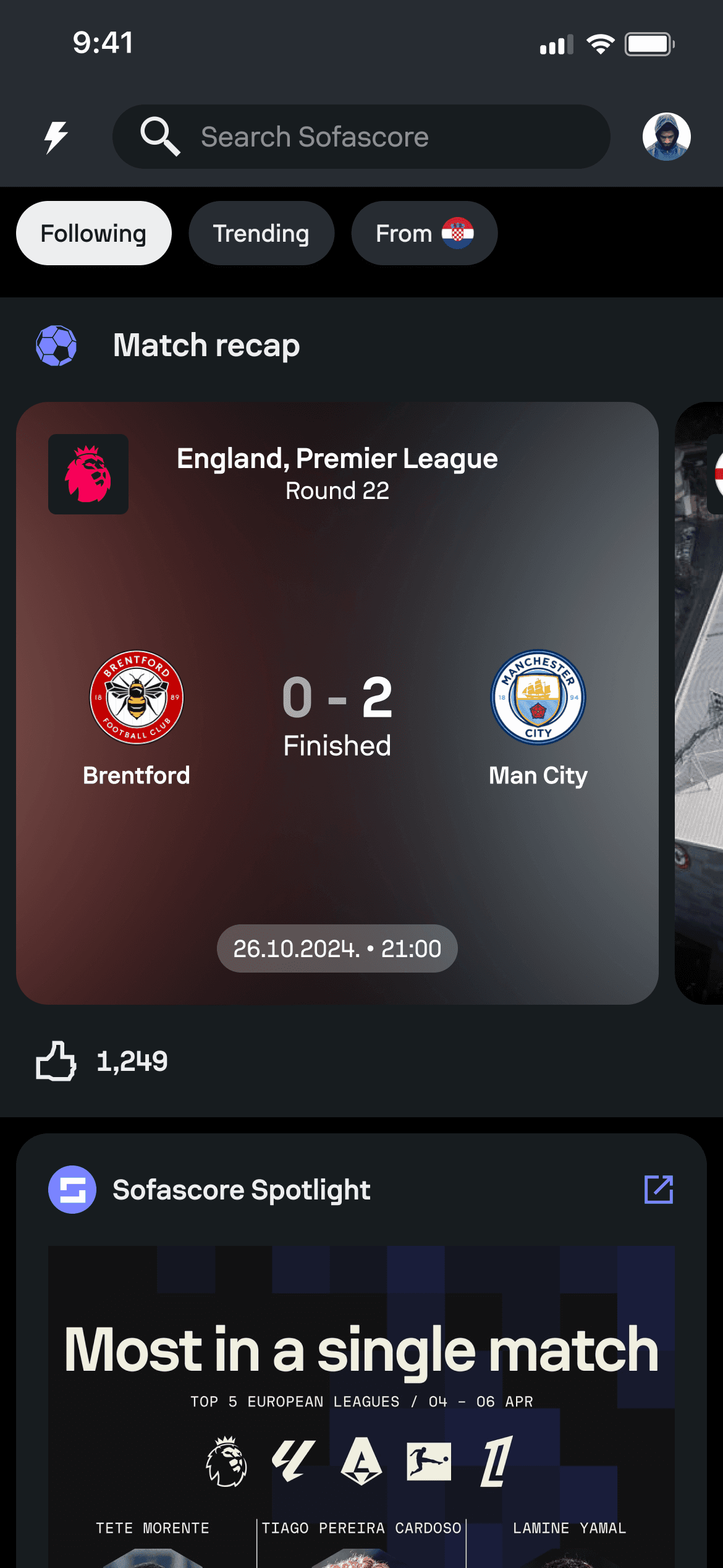
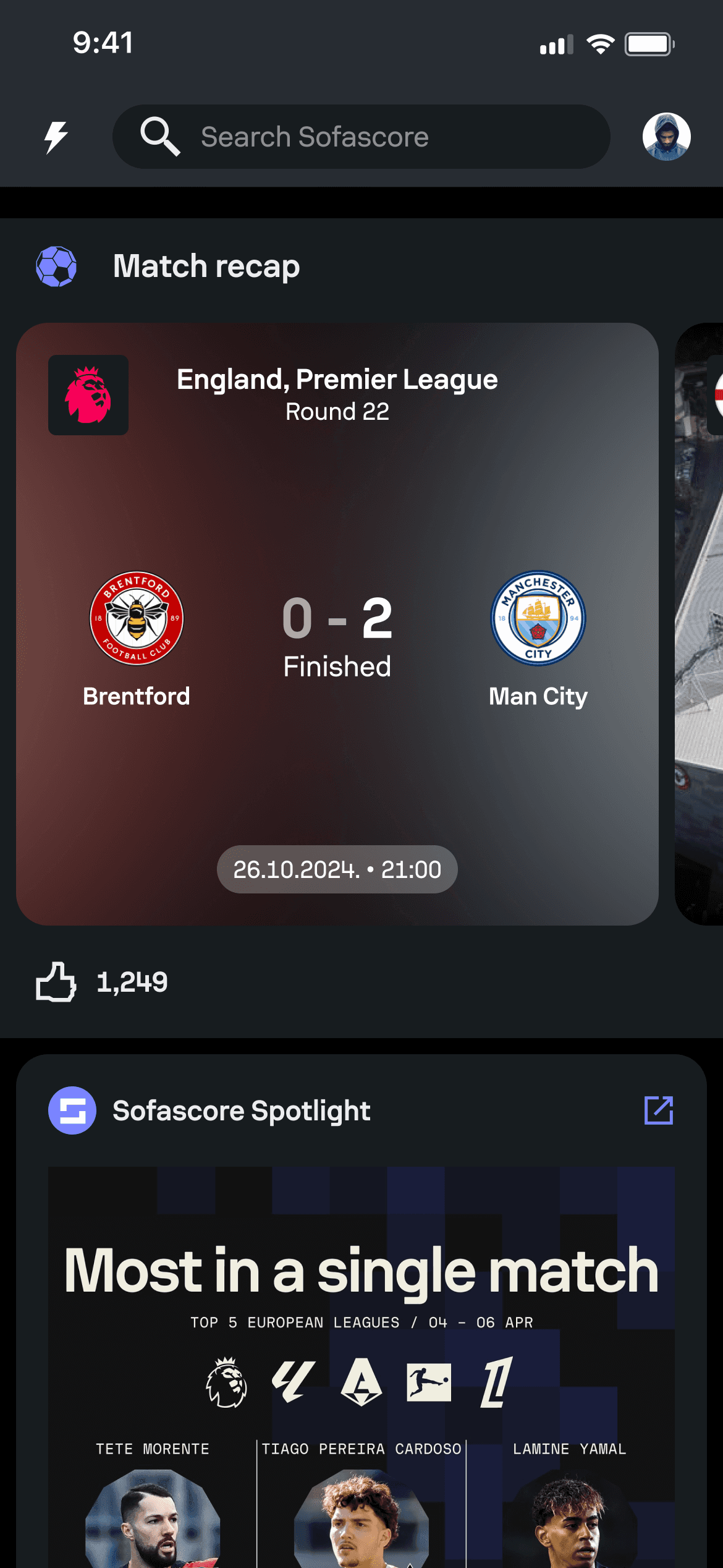
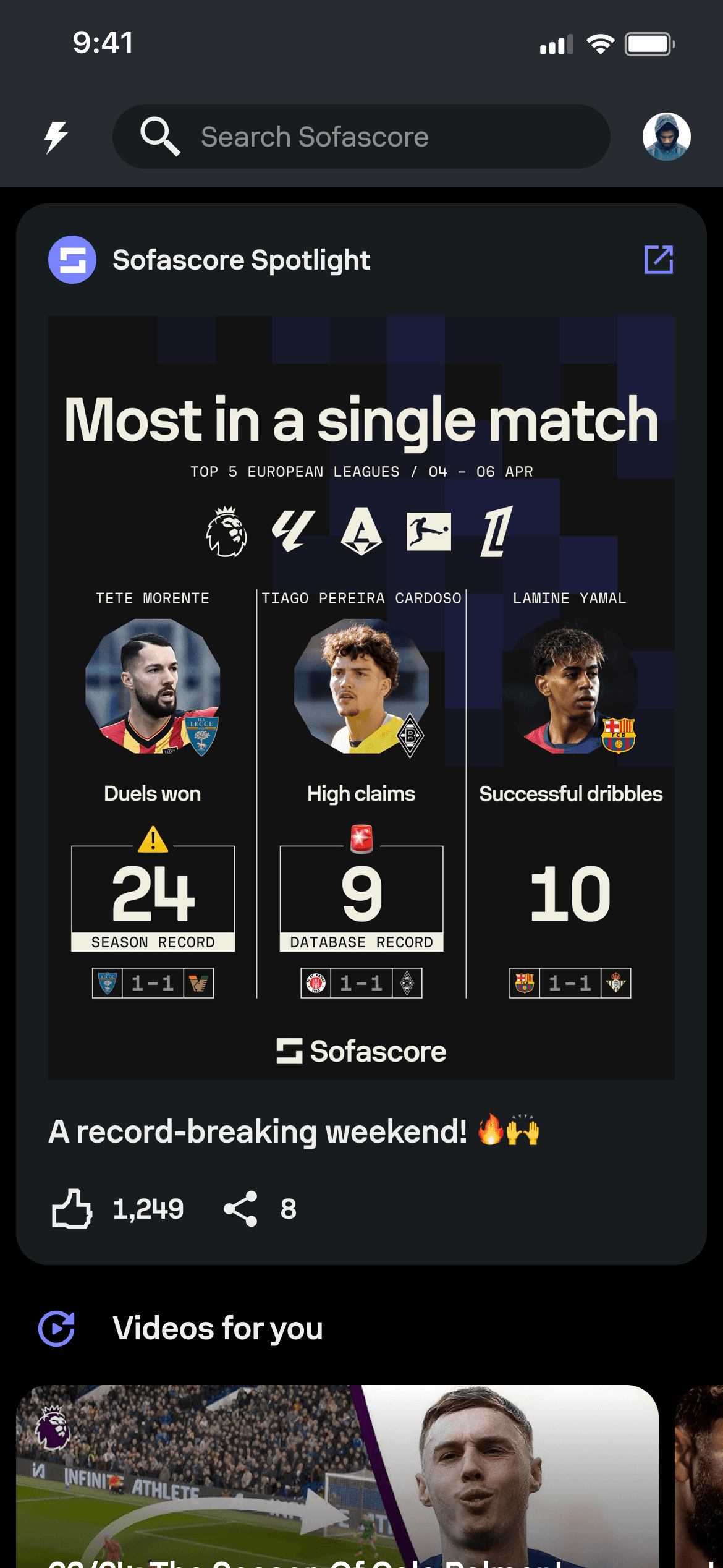
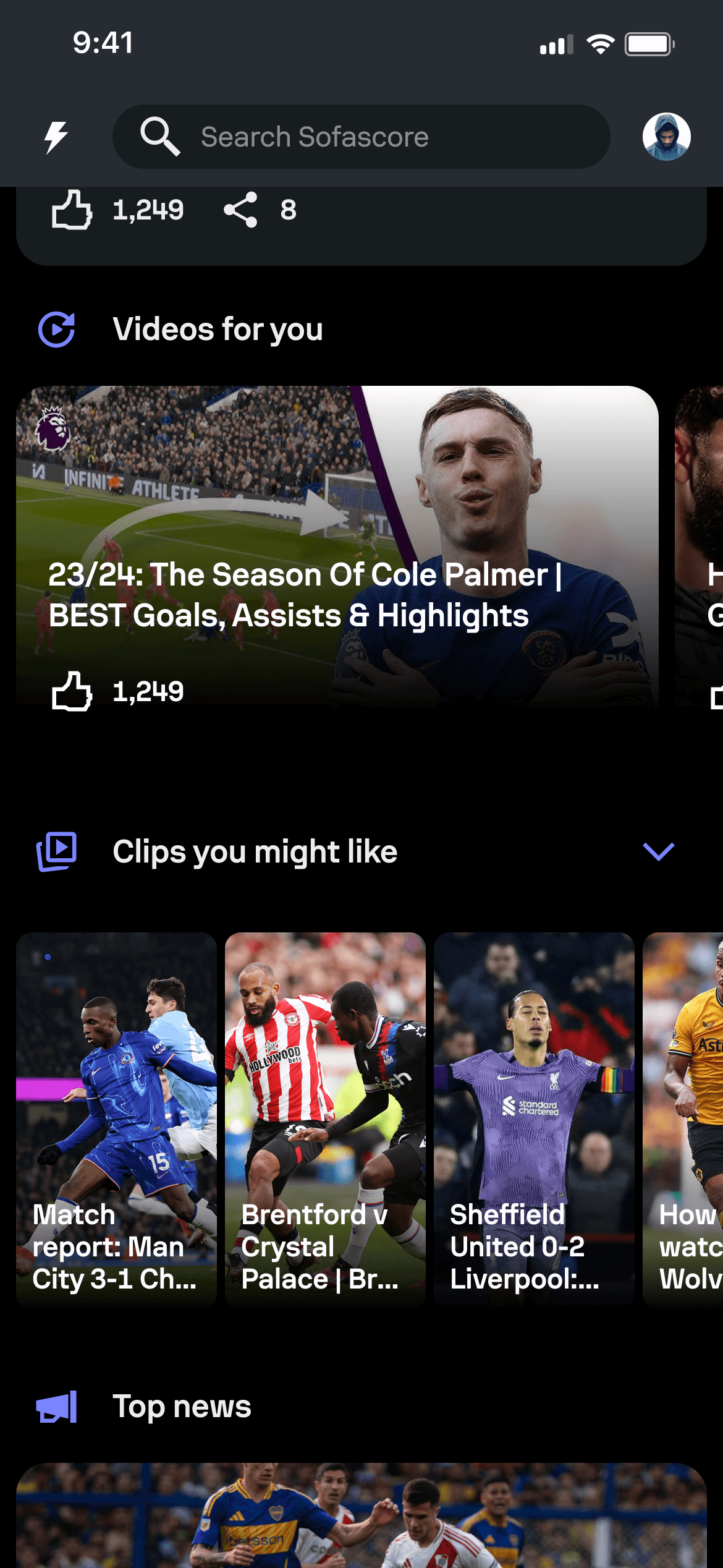
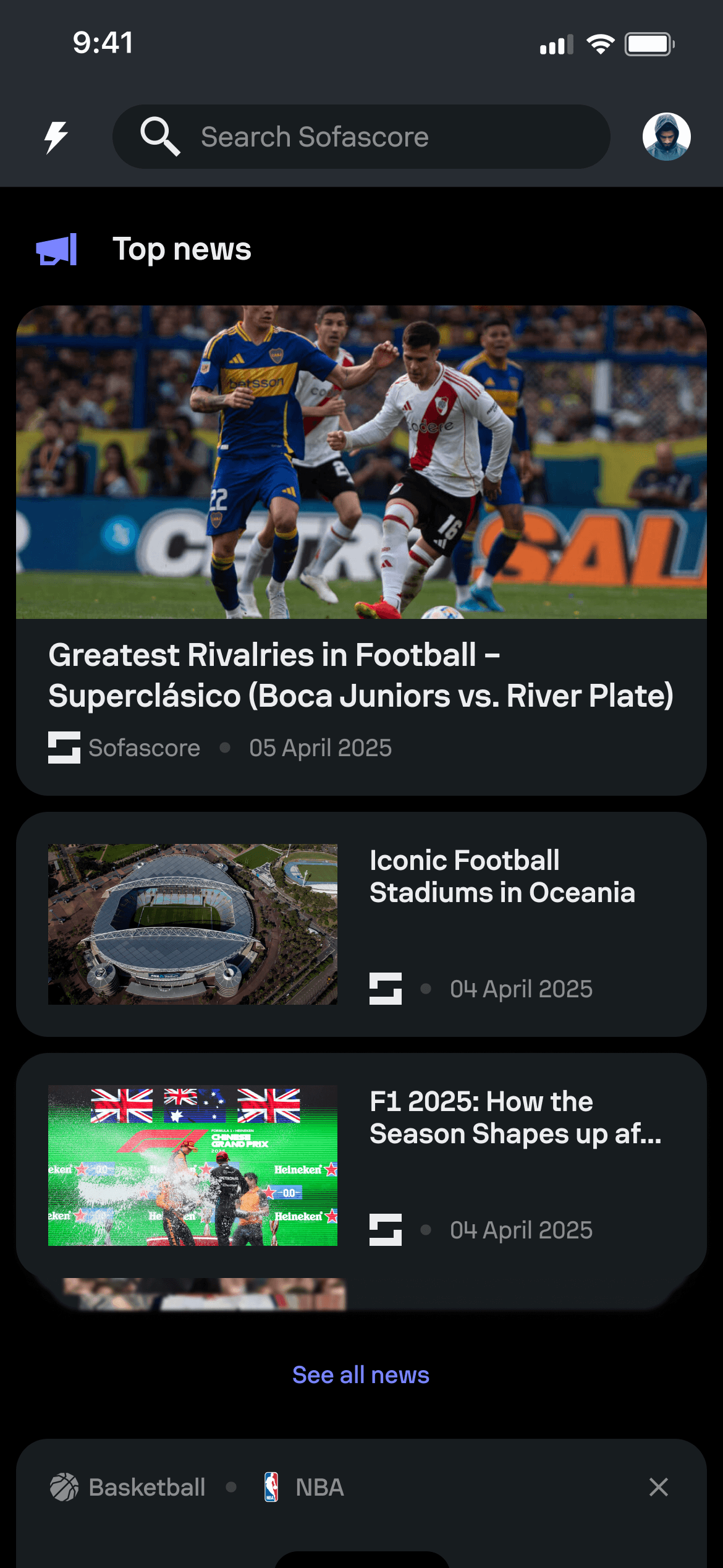
Three paths into discovery.
For You, Popular and Country let users move between personal relevance, regional momentum and local context.
Key takeaway
Feed was not one repeated card. It was a system for many different reasons to stop, understand and continue exploring.
05 - System
A reusable framework gave match context, editorial stories, video and sports data distinct behaviours within one hierarchy.
Reusable card patterns could be configured and published through the internal admin system, allowing content teams to extend the Feed without a new client implementation for every story.
System principle · Shared structure. Different content behavioursCommon spacing, metadata, interaction patterns and visual hierarchy kept the Feed coherent. The story itself, imagery, video, event context or Sofascore data, created the variation.
06 - Content formats
Timely formats created direct paths back into match and player context.
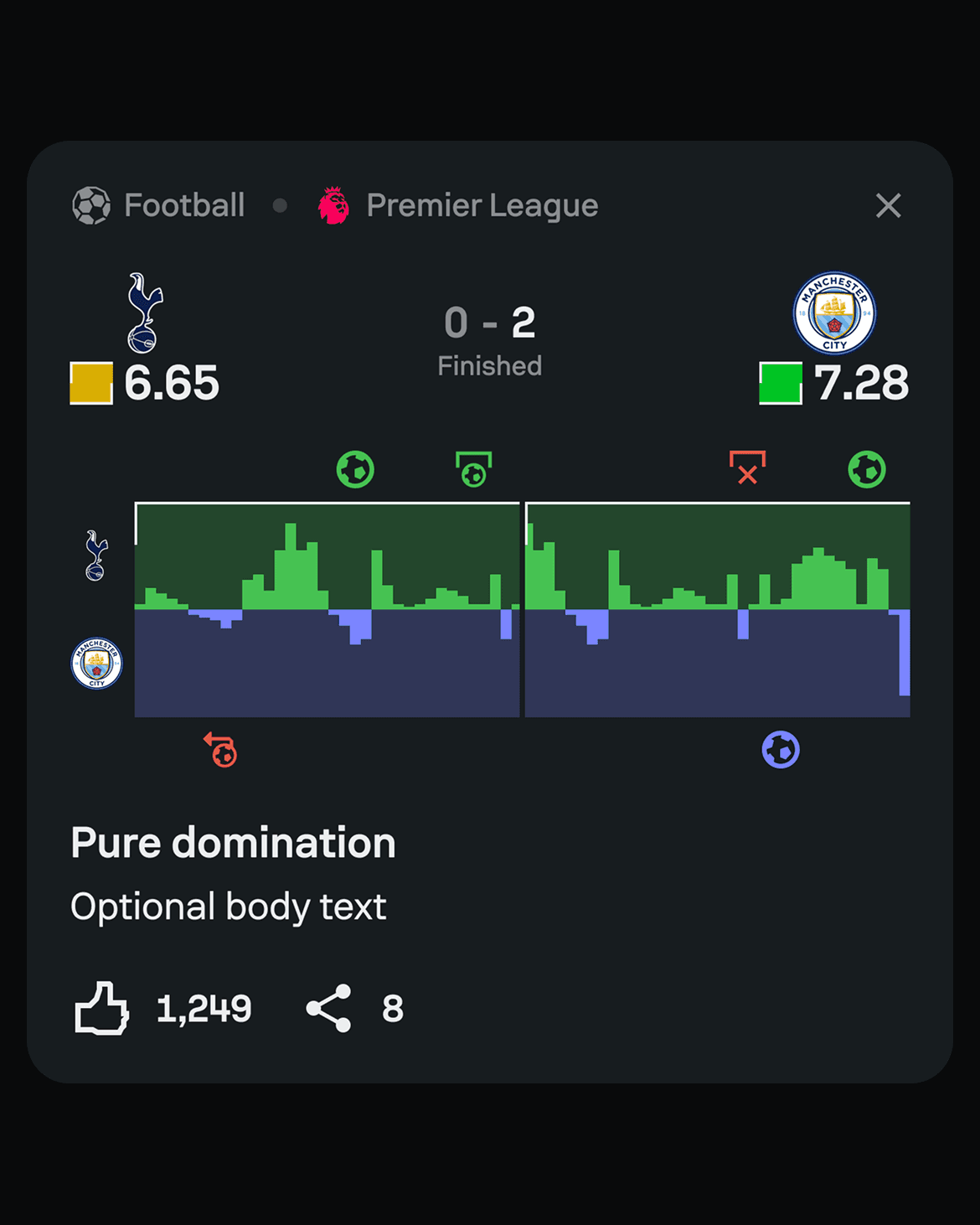
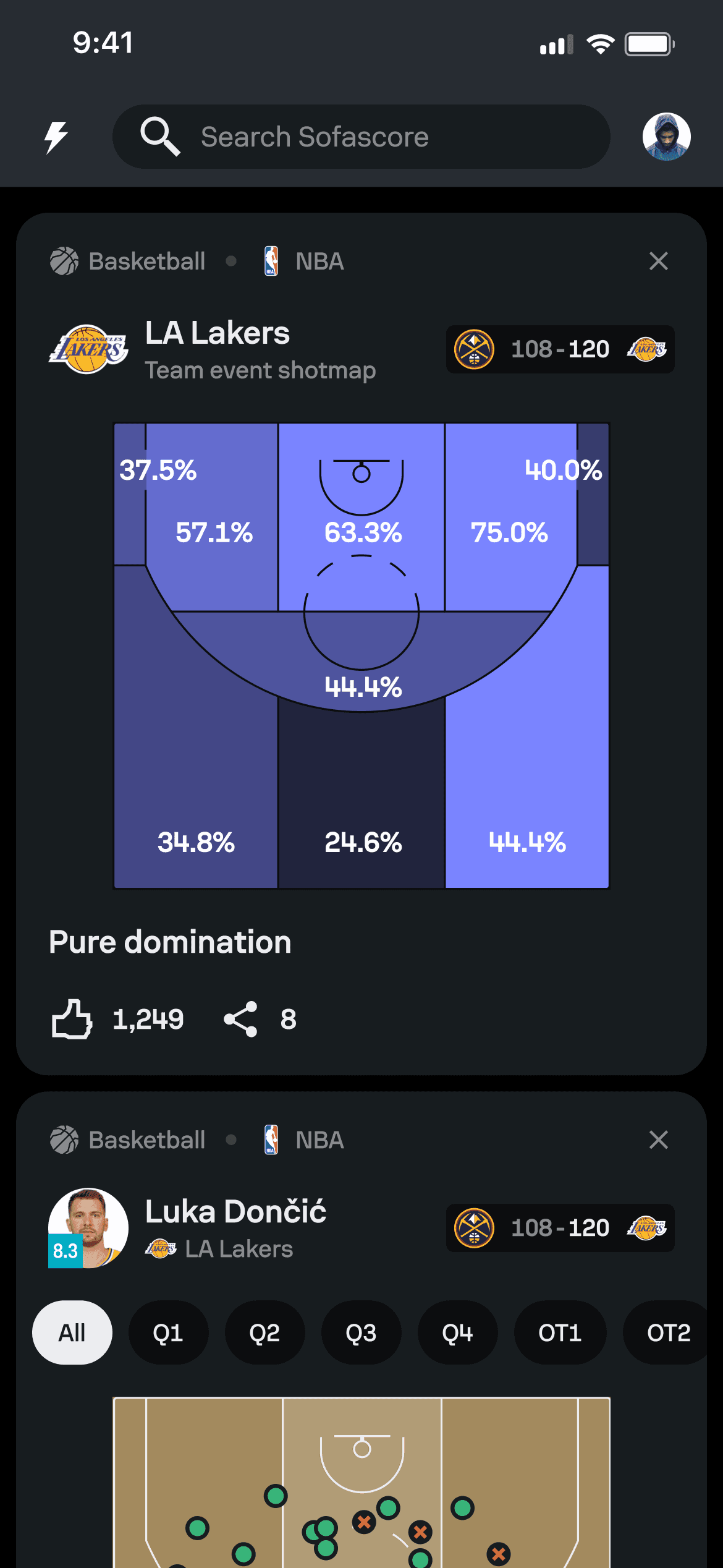
Editorial, personalised and social formats expanded discovery beyond scores.
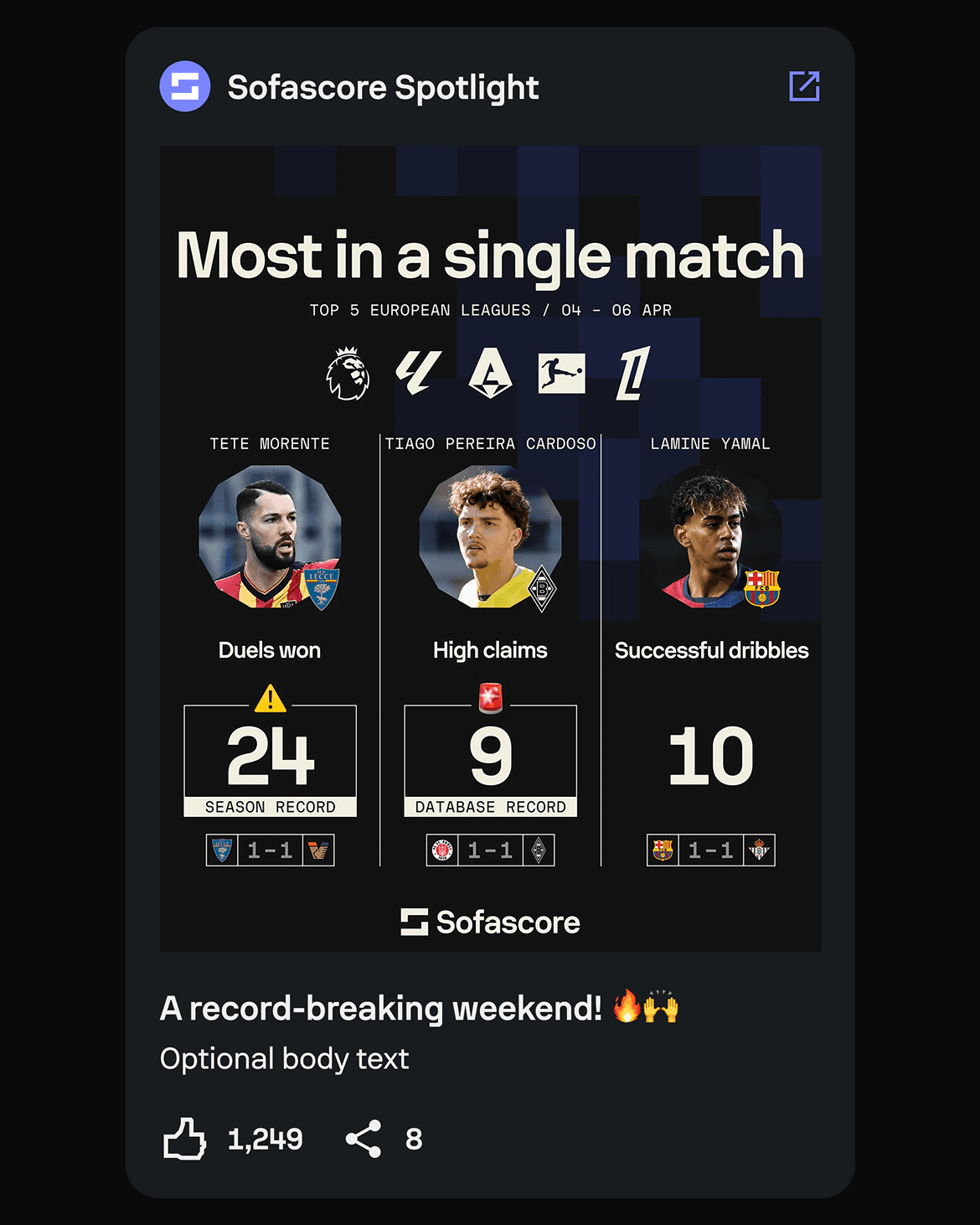
Video formats supported clips, short-form discovery and creator-led content.
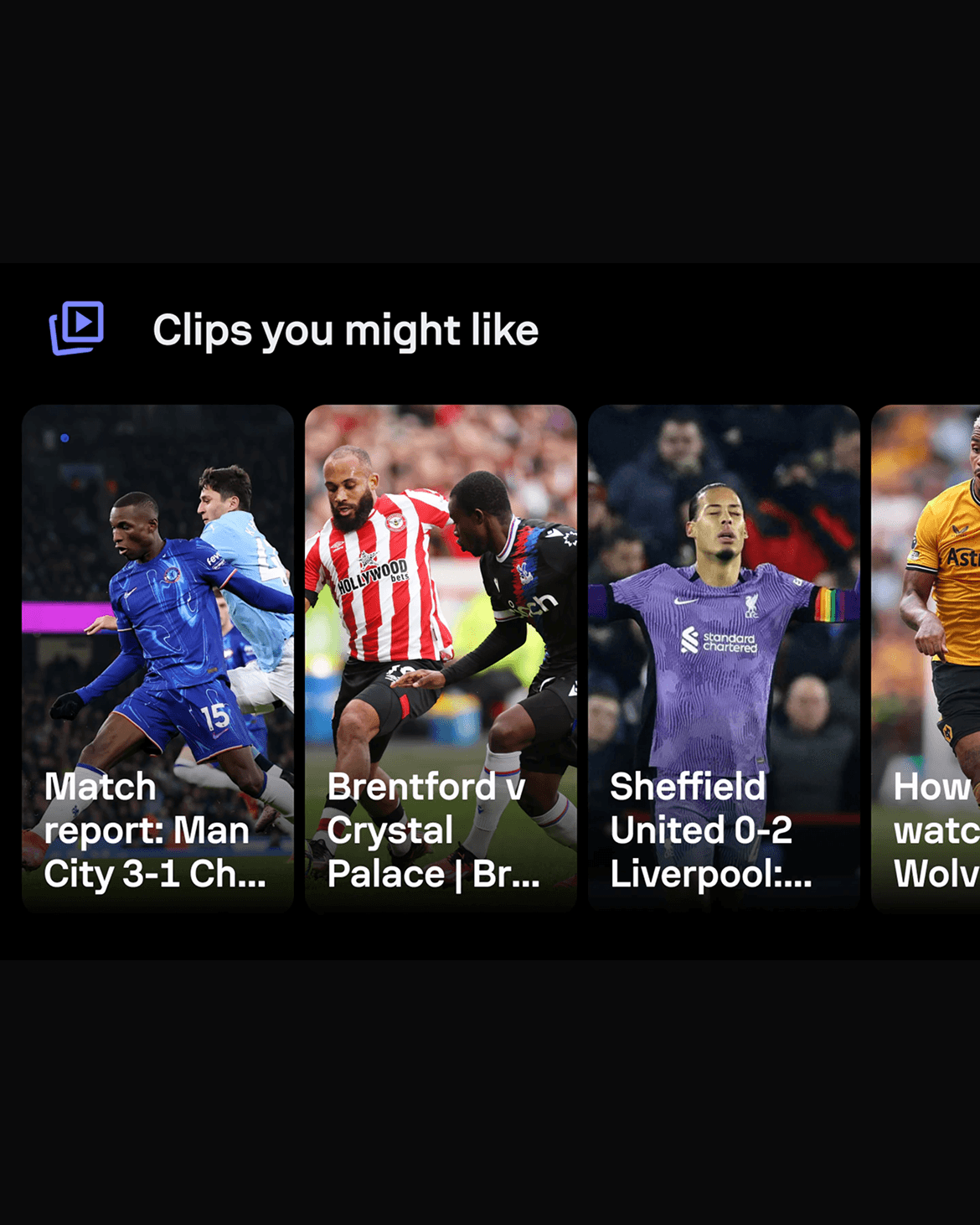
Each sport needed its own visual language; the surrounding card system kept them coherent.
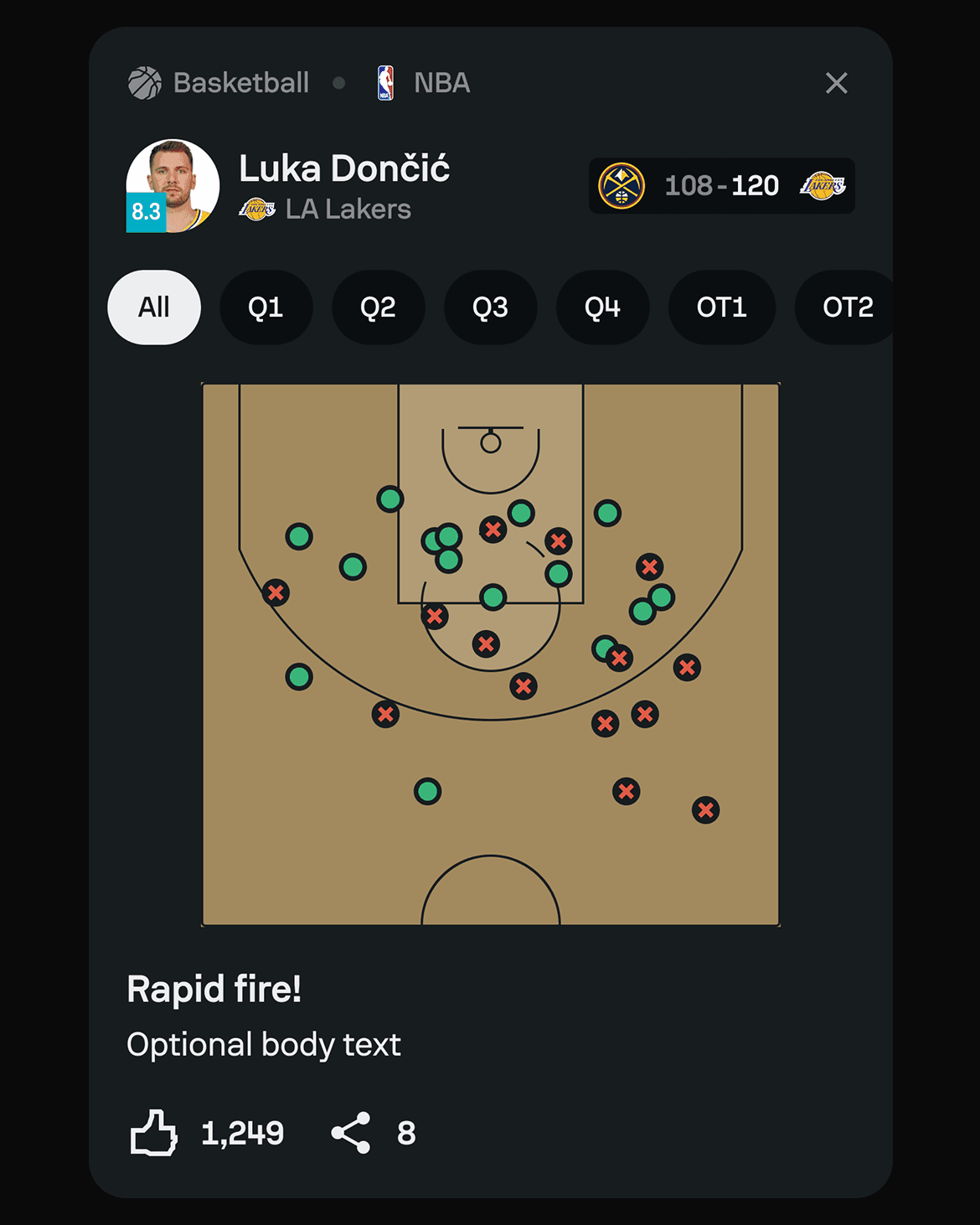
The system did not make every story look the same. It made very different stories feel like they belonged in the same product.
07 - Evolution
Event stack cards evolved from expressive editorial treatments toward a calmer hierarchy built for fast scanning.
The design shift · Less visual weight. Faster understandingThe goal was not to simplify the card for the sake of minimalism. It was to reduce everything that competed with the match itself, allowing users to recognise context and outcome faster while moving through the Feed.
08 - Evidence
Feed developed through staged rollout, recommendation experiments and continuous iteration.
01 · BETA PHASE
The first Feed structure and card models evolved through close collaboration with the Product Owner, design critique and implementation feedback.
02 · DECEMBER 2024
Feed became available to users with English as its app language, while recommendation sorting and regional-event logic started shaping discovery.
03 · JUNE 2025
Feed expanded to users worldwide and introduced distinct discovery paths around personal relevance, regional momentum and local context.
04 · ONGOING
Machine-learning testing, new content sources, additional sports and new card formats continue to shape the experience.
Selected card variants were prepared for testing, then refined through behavioural signals, feedback and product discussions.
Not every decision produced a clear numerical winner. In those cases, the team still needed to make a deliberate product choice and continue learning from the result.
Usage patterns and selected tests helped identify where users responded more clearly to one direction.
Product discussions, design critique and implementation feedback influenced hierarchy, card behaviour and visual treatment.
When data did not provide a conclusive answer, we made intentional decisions based on context, experience and what we believed created the stronger product.
09 - Outcome
Feed became a global product and permanent navigation destination, supported by a system designed to keep evolving.
GLOBAL REACH
Feed progressed from an initial language-based rollout into a globally available product experience inside the Sofascore mobile apps.
CORE DESTINATION
Feed moved beyond an experimental surface and became one of the primary destinations users could access directly from the bottom navigation.
SCALABLE FOUNDATION
The system could continue absorbing new sports, content sources, card formats and recommendation approaches without rebuilding the experience from scratch.
Evidence boundaryThis case study uses verified product milestones as its outcome signal. It does not claim a single behavioural uplift where experiments were ongoing, inconclusive or not attributable to one design change.
Not a finished collection of cards. A system designed for change.
New formats could be added without losing the visual hierarchy, interaction patterns and product identity that made Feed feel coherent as one experience.
10 - Reflection
Designing discovery meant creating a system that remained understandable while the product around it changed.
SYSTEM THINKING
The strongest solutions came from defining shared hierarchy and interaction patterns first, then giving each content format enough freedom to serve its own purpose.
DECISION MAKING
Behavioural signals and testing improved decisions, but product context, design critique and experience still mattered when the data did not provide a clear answer.
CONTINUOUS CHANGE
New sports, sources, formats and recommendation models continuously changed the problem. The design needed to support evolution rather than optimise for one final state.
Personalisation is not only about ranking the right content. It is about making its relevance immediately understandable.